
India's recorded music industry generated ₹59 billion in 2025 and is projected to reach ₹75 billion by 2028, but that growth is concentrated in the hands of a handful of gatekeepers — and the path to a record deal in India looks nothing like the Western model most artists are familiar with. This guide gives you the full picture: how India's label ecosystem actually works, what A&R managers are looking for in 2026, the five deal types you might be offered, and the contract clauses that have cost Indian artists their masters, their royalties, and their creative freedom.
Key takeaways
- India's recorded music market hit ₹59 billion in 2025 — but only 8% of 178 million streamers pay for subscriptions, which means label revenues remain structurally constrained (Music Business Worldwide, 2025)
- T-Series controls 40.7% of Indian major label revenue — but its revenues actually fell 6.4% in 2024, while Warner Music India grew 181% from a small base (Music Ally, January 2025)
- Major Indian labels (Sony, UMG, Warner) do not accept unsolicited demos — a music manager or entertainment lawyer is your mandatory first step
- The 360 deal is used in India: labels take a cut of tours, merchandise, and brand endorsements, not just recordings — understand what you're signing
- Independent labels held 26% of India's recorded music revenue in 2023 (IFPI data); India is now TuneCore's 2nd largest market globally by artist sign-ups (TuneCore India Five-Year Report, June 2025)
India's Music Label Landscape in 2026
India's label ecosystem divides into three distinct worlds: the Bollywood-facing major labels, the independent and hip-hop labels, and the emerging artist-owned label structures. Understanding which world applies to you shapes every decision that follows.
Quick stat: The six largest Indian music companies grew their combined revenues 6% to ₹3,843 crore in 2024. T-Series holds 40.7% of that figure — but is the only major label whose revenues declined year-on-year. (Music Ally, January 2025)
Here are the key labels in India's music ecosystem in 2026:
| Label | Type | Genre Focus | Key 2024–2026 Move | Accepts Cold Demos? |
|---|---|---|---|---|
| T-Series | Major (domestic) | Bollywood, Punjabi pop, bhakti | Largest YouTube channel globally (280M+ subscribers) | No |
| Sony Music India | Major (international) | Bollywood, Hindi/Tamil pop | Launched Day One sub-label for emerging artists | No |
| Universal Music India | Major (international) | Bollywood, hip-hop, South Indian | Acquired 30% of Excel Entertainment; partnered with Albuquerque Records | No |
| Warner Music India | Major (international) | Bollywood crossover, pop | Signed Ayushmann Khurrana; distribution deal with Ultra Music India | No |
| Zee Music Company | Major (domestic, Bollywood) | Bollywood film soundtracks | Signed Adnan Sami (March 2026); invests in 50%+ of new Bollywood releases | No |
| Saregama India | Major (domestic) | 150,000+ song catalog; licensing | Rs. 325 crore invested in Bhansali Productions; partnered for all future soundtracks | Limited |
| Tips Music | Major (catalog) | Classic Bollywood catalog | 25–30% of budget on new content; Warner distributes globally | No |
| YRF Music | Vertically integrated | YRF film soundtracks only | Part of ongoing ED probe into non-payment of artist dues | No |
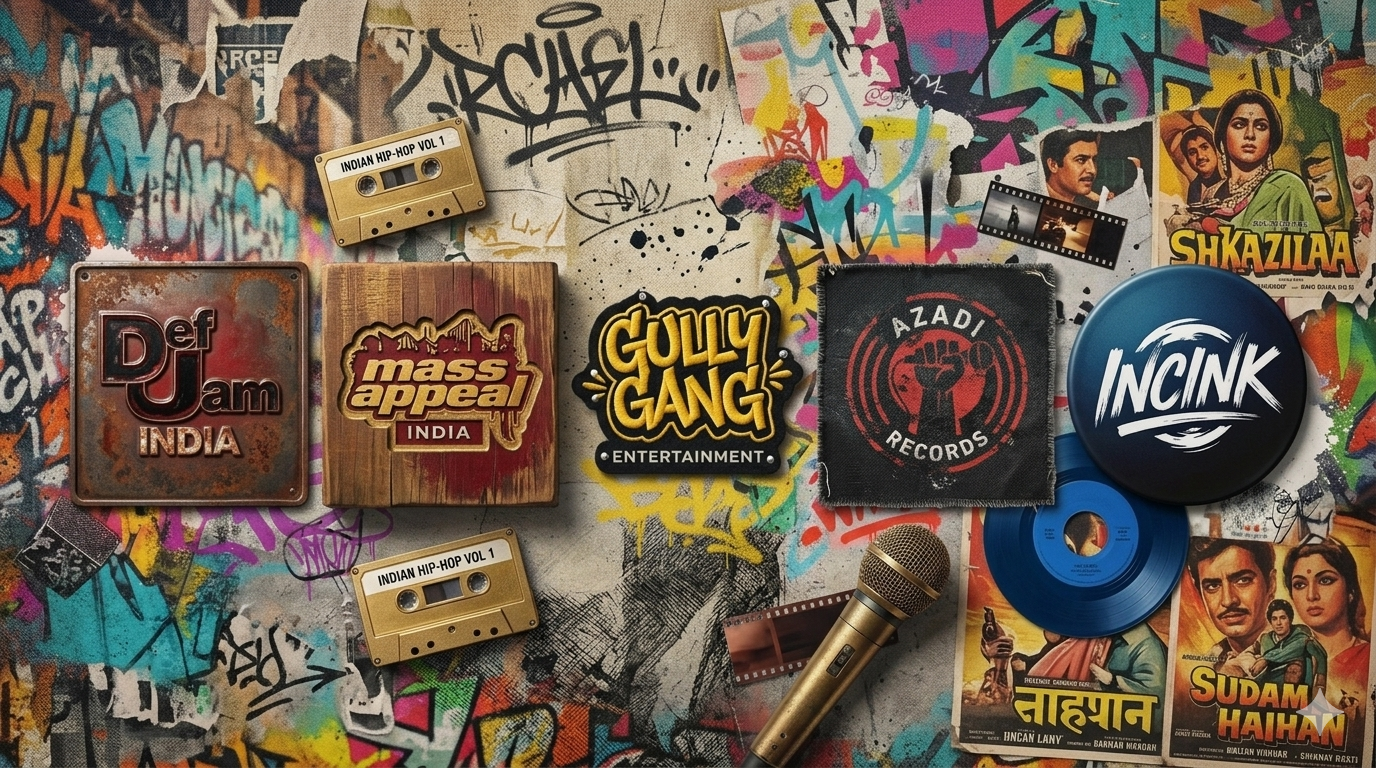
| Azadi Records | Independent | Hindi/Urdu underground hip-hop | Seedhe Maut, Mellow D, Yungsta; artist-collective model | Via referral |
| Gully Gang Entertainment | Independent | Desi hip-hop, gully rap | DIVINE's own label; co-releases via Mass Appeal India / UMG | Via referral |
| Mass Appeal India | JV (UMG + Nas's Mass Appeal) | Indian hip-hop | First India major label hip-hop JV; DIVINE as anchor act | Via referral |
| Day One (Sony) | Sub-label | Emerging South Asian pop/indie | First signings: Tanmaya Bhatnagar, Pina Colada Blues, Kasyap | Via manager |
| Albuquerque Records | Artist-owned + UMG distro | South Indian pop, hip-hop | Anirudh Ravichander's own label; UMG handles global distribution | No |
| Believe Music India | Distribution / label services | All genres | Acquired Think Music (South India); distribute 160+ DSPs | Services, not signing |
The Bollywood distinction: T-Series, Zee Music, YRF, and Sony Music India primarily sign film composers (to acquire soundtrack rights) and work with playback singers on a per-track, work-for-hire basis — not multi-album artist deals. If you're an independent songwriter or producer, the Bollywood label pathway is largely not relevant to you unless you're placing songs in films.
The most relevant pathways for independent artists are Sony's Day One, Mass Appeal India (for hip-hop), Azadi Records, and the growing cluster of artist-owned labels distributed through UMG or Believe.
Build your artist profile and get in front of label scouts and A&R contacts. kredl →
Types of Record Deals: What Indian Labels Actually Offer
Before you sign anything, you need to know what kind of deal is on the table. India uses all five deal structures found in Western markets, but their prevalence here is different.
1. Traditional recording deal The label pays an advance (recoupable from your future royalties), acquires ownership of your master recordings — often in perpetuity — and pays you a royalty of typically 12–20% of net receipts. Your advance is only recouped from your royalty share, not from the label's marketing spend. An artist on 15% royalty who receives a ₹50 lakh advance needs to generate ₹3.33 crore in royalty-attributable net receipts before seeing an additional rupee. Many Indian artists never recoup.
2. Distribution deal You own your masters. A distributor (DistroKid, TuneCore, Deliver My Tune, Believe) places your music on DSPs and takes 0–30% of revenues. No advance, no control over your catalogue. This is the fastest-growing model in India — the country is now TuneCore's 2nd largest market globally.
3. 360 deal (multiple rights deal) The label takes a percentage of all your revenue streams: recordings, touring fees, merchandise sales, brand endorsements, and sync placements. This structure is used by major Indian labels for new signings. It creates real risk: "the artist receives only a percentage of record sales as royalty" while the label takes cuts from revenue streams it may have done nothing to develop. If the label isn't actively booking your tours or managing your endorsements, you're giving up income for nothing in return.
4. Label services / artist services deal The label provides specific services — digital distribution, marketing support, playlist pitching, PR — for a fee or revenue share, without acquiring your masters. Believe Music India is the primary example of this model in India. This is the right structure for mid-tier artists who have built leverage and want support without giving up ownership.
5. Licensing deal You retain your masters and license specific recordings to a label for a defined territory and term. More common for catalog deals (Tips Music licensing its catalog to Warner for global distribution) than for emerging artist deals. Worth pursuing if you've built a meaningful back catalog independently.
Quick stat: Digital licensing contributed 62% of Indian label revenues in 2024 — down from 68% in 2023, partly because three major streaming platforms (Wynk, Resso, and Hungama) all ceased operations in India, consolidating the market around JioSaavn, Spotify, YouTube Music, and Gaana. (Music Ally, January 2025)
What Indian Labels Are Actually Looking For in 2026
India's A&R landscape in 2026 is, as one industry observer put it, "more data analysis than talent discovery." Major labels chase artists who are already commercially viable rather than developing raw talent. That's both a challenge and an opportunity: it means your leverage comes from building your own numbers before you knock on any door.
Streaming metrics come first. There's no officially published minimum threshold from any Indian label, but industry consensus puts meaningful label attention starting around 1 million monthly Spotify listeners or 10 million YouTube channel views. JioSaavn editorial placement or a track consistently hitting algorithmic playlists on any major platform is a strong signal.
Social engagement rate matters more than follower count. A 9% engagement rate on 150,000 Instagram followers is more valuable to an A&R conversation than 0.4% on 1.5 million. Labels are looking for evidence of real community, not inflated audience numbers.
Regional language appeal is the growth opportunity. Tamil, Telugu, Punjabi, and Bengali language music is growing at double the rate of Hindi music in streaming numbers. Gaana reported a 96% increase in local-language streams; regional language content grew 112% in some categories (IBEF, 2025). A proven regional audience is increasingly attractive to labels that were previously exclusively Bollywood-focused.
Sync placement is a credibility marker. A track placed in a Netflix India or Amazon Prime Video original series — even in a background or montage moment — signals that your music works in a commercial context. Labels notice OTT sync credits.
Live performance history carries weight at indie labels. Mass Appeal India, Azadi Records, and the Day One roster all value live performance credibility. NH7 Weekender, Lollapalooza India, and Magnetic Fields appearances signal that an artist has real community support.
Management representation is often the prerequisite. Sony Music India and Universal Music India do not look at unsolicited demos — period. Having a reputable music manager is frequently the only way your material gets heard by A&R. Getting a manager is step one, not step four.
Find music managers, A&R contacts, and industry professionals across India. kredl →
How to Get a Label's Attention: The Real Pathway
The romanticised version — send your best track to a label inbox and wait for a call — doesn't exist in India. Here's what the actual process looks like.
Step 1: Build your EPK (Electronic Press Kit). Before any label conversation, you need: a 200-word artist bio, professional photos, streaming links to your 3–5 best tracks, a Spotify for Artists screenshot showing monthly listeners and audience demographics, social media handles with engagement metrics, a live performance video, and any press coverage. This is your calling card in every industry conversation.
Step 2: Get management. Major labels in India won't take your material without an industry professional introduction. A manager, entertainment lawyer, or booking agent with existing label relationships is the practical gateway. Research managers who work with artists in your genre — not just the biggest names, but mid-tier managers building rosters who might be open to new signings.
Step 3: Target the right label for your music. Approaching T-Series as an underground hip-hop artist wastes everyone's time. Mass Appeal India, Azadi Records, and IncInk are the relevant targets for Indian hip-hop. Day One (Sony Music India) is the right target for English-language or experimental Indian pop. Saregama Fresh is worth understanding for non-film singer-songwriter acts. Match genre and aesthetic before you reach out.
Step 4: Use industry events strategically. Indian label scouts attend NH7 Weekender, Lollapalooza India, and Magnetic Fields — not as passive music fans but as professional scouts. Getting on those lineups is itself a major credibility signal. If you can't get on the lineup yet, attending as a professional and building real relationships with industry people over time is the slower but legitimate version of the same path.
Step 5: LinkedIn outreach to named A&R contacts. General enquiry inboxes at major labels go nowhere. Identify the specific A&R manager or director at the label relevant to your genre — this information is publicly available on LinkedIn. A targeted, professional connection request with a short note is more effective than any demo email.
7 Contract Red Flags Indian Artists Must Know
India's music industry has a documented history of predatory contract terms. In 2025, the Enforcement Directorate raided the offices of T-Series, Saregama, Universal Music India, and Yash Raj Films as part of a probe into alleged non-payment of dues to artists — a reminder that even major labels have enforcement problems. Before signing anything, watch for these seven clauses.
1. "In perpetuity" master ownership with no reversion clause This is the most dangerous clause in any Indian recording contract. It means the label owns your master recordings forever — you never get them back regardless of the label's performance. Any contract without a specific master reversion clause (e.g., "masters revert to artist after 15 years or if label fails to commercially exploit within 3 years") is a red flag.
2. Below 12% royalty rate The Indian music industry benchmark is 12–20% of net receipts. Anything below 12% is inadvisable to sign without significant offsetting benefits (a very large advance, or specific marketing commitments in writing).
3. 360 deal with no corresponding obligation A 360 deal is only acceptable if the label is contractually obligated to invest in your touring, merchandising, and brand partnership development. If the label takes a cut of your endorsements but has no obligation to book you any, walk away.
4. More than three album options Standard Indian deals include label options for additional albums — typically 3. Anything beyond three albums, exercisable at the label's sole discretion, effectively locks you in for a decade at contract terms you negotiated as an unknown artist.
5. Publishing rights bundled into the recording contract Recording rights (who owns the master) and publishing rights (who owns the songwriting) are separate. Some Indian labels bundle a publishing rights assignment into the recording deal. Retain your publishing rights separately. Register independently with IPRS (Indian Performing Right Society) for performance royalties, which the label cannot contractually waive under the Copyright (Amendment) Act, 2012.
6. Social media approval clauses without a sunset Emerging in recent Indian contracts — the label claims approval rights over your Instagram posts, YouTube videos, and brand deals. This is acceptable for a limited initial period (say, the first six months of a release campaign) but must have a clear sunset date. An open-ended social media control clause is a red flag.
7. Non-compete extending more than one year post-termination Contracts that prevent you from releasing music elsewhere for more than one year after the deal ends are structurally unfair. Challenge any non-compete with duration over 12 months post-termination.
Know your legal rights: The Copyright (Amendment) Act, 2012 granted composers, lyricists, and music creators the right to receive ongoing royalties even after assigning rights to a label. This right cannot be contractually waived. The 2025 Rule 83A update requires copyright owners to maintain online platforms for collecting licence fees, reducing the opacity of historical licensing transactions. Have an entertainment lawyer review any contract before signing.
Do You Even Need a Record Deal in 2026?
The honest answer for most Indian artists: not necessarily. The independent path has never been more viable.
India is TuneCore's 2nd largest market globally by artist sign-ups. In the five years from 2020 to 2025, total music releases on TuneCore India increased 9.3 times. Hindi releases alone grew 12x. The platform generated 13 billion streams for independent Indian artists over that period, with 1 in 20 streams coming from outside India — demonstrating that independent Indian music is crossing borders without any label support (TuneCore India Five Years of Independent Voices, June 2025).
The artists building the most sustainable careers in India's music ecosystem in 2026 are operating on a different model:
- Anirudh Ravichander built his own label (Albuquerque Records) and then partnered with UMG for distribution — on his terms, with master ownership intact
- Badshah launched Pentertainment 0075 as his own label in partnership with UMG, rather than signing to UMG as an artist
- DIVINE built grassroots credibility through Gully Gang before partnering with Mass Appeal India, retaining creative and structural control
- Seedhe Maut achieved national and international recognition on Azadi Records, an independent label, without any major label involvement
The practical checklist for choosing between independent and signed:
| Question | If Yes → | If No → |
|---|---|---|
| Does the label offer significant marketing investment in writing? | Consider signing | Evaluate independent path |
| Do you retain any master ownership or reversion rights? | Potential deal | Red flag — negotiate or walk |
| Does the label have demonstrated expertise in your genre? | Positive signal | Risk that they'll mismarket you |
| Can you build the same audience independently in 2 years? | Go independent | Label support may accelerate |
| Is the advance enough to fund your next 2 years of creative work? | Consider signing | Low advance, low upside |
Connect with music lawyers and managers who understand India's label contracts. kredl →
Frequently Asked Questions
How long does it take to get a record deal in India?
There's no standard timeline. Artists who approach labels through proper channels — with management representation, strong streaming numbers, and a professional EPK — typically wait anywhere from three months to two years for a deal to close. Labels move slowly in India, and the decision chain (A&R → label head → legal → business affairs) adds months to any timeline. Building your independent audience while that process happens is not optional — it's leverage.
Do Indian labels pay advances? How much?
Yes, Indian labels pay advances — but specific figures are not publicly disclosed. Advances are recouped from your royalty share only (not from the label's marketing spend), which means a large advance can paradoxically delay when you see any royalty income. India's subscription ARPU (average revenue per user) is among the lowest globally — approximately ₹715 per subscriber per year — which structurally caps what Indian labels can advance compared to Western markets with subscription ARPUs of ₹9,000–₹10,000+. Expect Indian advances to be meaningfully lower than Western equivalents at equivalent career stages.
Is it safe to sign with smaller or regional Indian labels?
Smaller labels can offer better deal terms — higher royalty rates, shorter option periods, less onerous 360 language — because they have less negotiating power. The risk is lower marketing resources and weaker relationships with DSP editorial teams. Verify any smaller label's track record: have their previous signings actually received marketing support, editorial placement, and regular royalty payments? Ask to speak with current or past artists on their roster before signing.
What happens to my music if the label shuts down?
This is where master reversion clauses become critical. If a label folds and holds your masters without a contractual reversion trigger, you can find yourself in an expensive legal dispute to recover your own recordings. Require a clause that specifies masters revert to you in the event of label insolvency, acquisition, or failure to commercially exploit the recordings within a defined period (typically two to three years).
Can an Indian artist sign to a global label directly without going through their India office?
Yes, though it's rare. An Indian artist with substantial international streaming numbers (1 million+ monthly listeners on Spotify with significant international listener share) can attract attention from international A&R teams at UMG, Sony, or Warner's global offices rather than their India operations. The 2024 launch of Dialled In Records in London (a South Asian music label in partnership with Island-EMI / Universal UK) is a specific example of a label built for this scenario. This path requires demonstrable international audience traction, not just domestic success.
India's recorded music industry is growing and evolving faster than at any point in its history. Getting a record deal here in 2026 is a real possibility — but it's a different kind of deal than it was five years ago. Labels have become more data-driven and less artist-development-focused. The independent path has become genuinely competitive. And the contract terms that artists sign today determine whether the music they're making now will still be theirs in twenty years. Go in with your numbers strong, your manager in place, and your lawyer reading every clause before you sign.
Find the music industry professionals who can help you navigate India's label ecosystem. kredl →